

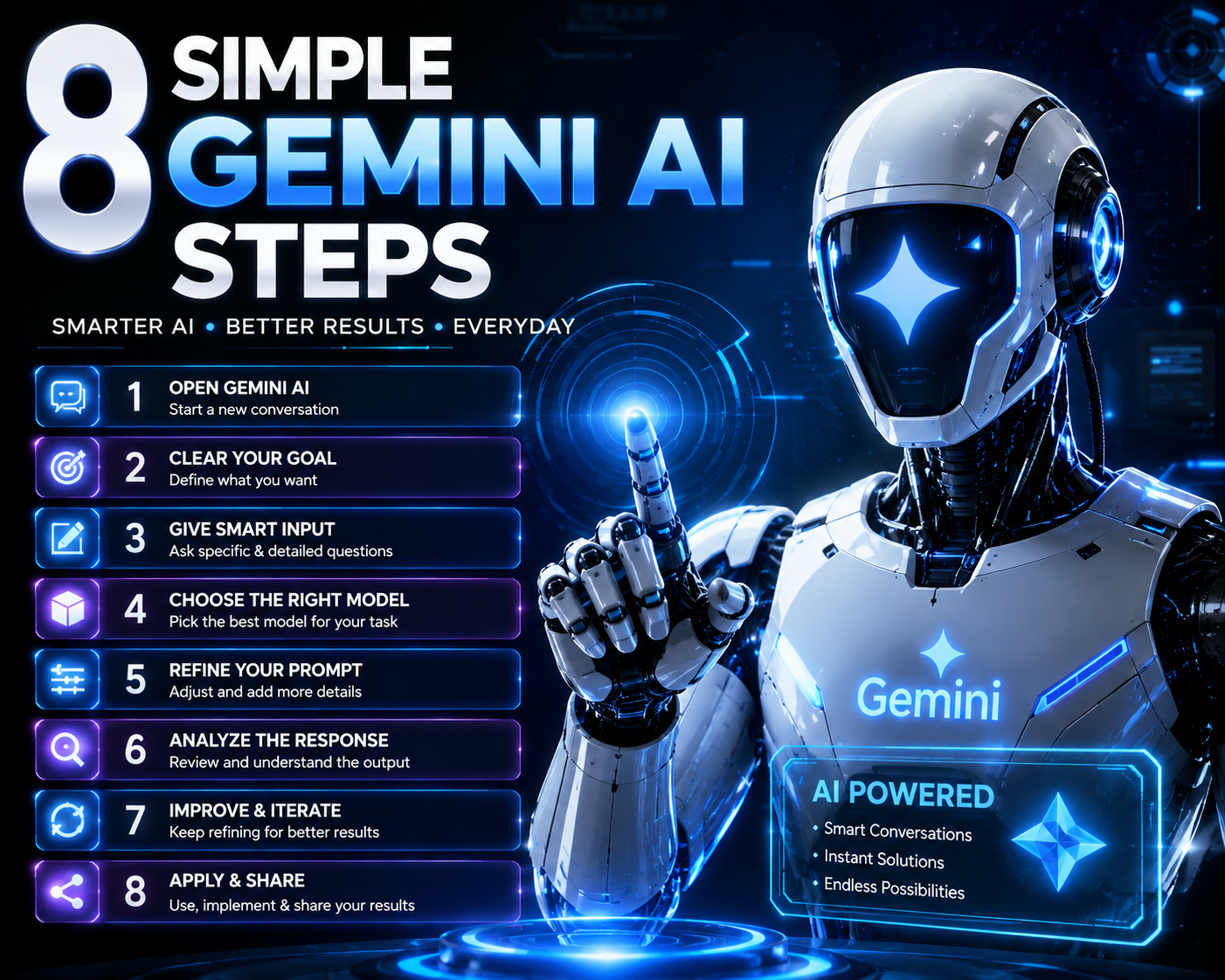
Discover 8 Simple Gemini AI Steps to automate daily tasks, summarize content, and boost your overall productivity fast
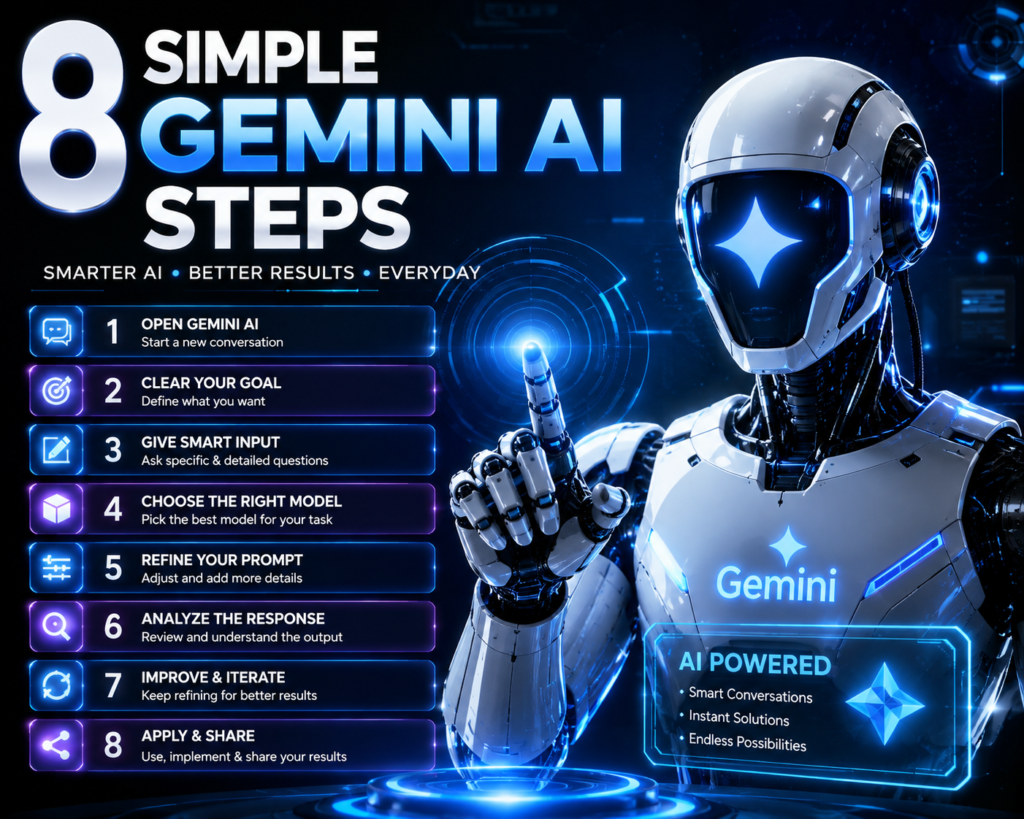
8 Simple Gemini AI Steps: The Complete Guide to Mastering Smart Workflows
Artificial intelligence has rapidly shifted from a futuristic concept into an indispensable daily tool. Among the most capable AI platforms available today is Google Gemini. Whether you want to draft professional communications, summarize complex research, analyze data spreadsheets, or streamline administrative overhead, following 8 Simple Gemini AI Steps can completely redefine your productivity.
Many users open an AI interface, type a basic prompt, and feel underwhelmed by the generic response. However, the real power of artificial intelligence lies in how systematically you structure your interactions. By mastering these 8 Simple Gemini AI Steps, you can transform a basic chatbot into a hyper-efficient personal assistant tailored to your exact professional standards.
This comprehensive, 2,000-word guide breaks down the core mechanics, advanced techniques, and contextual workflows required to get the most out of Google Gemini.
Understanding the Power of 8 Simple Gemini AI Steps
Before jumping into individual features, it is vital to understand why a structured workflow matters. Google Gemini operates on large language models (LLMs) that rely heavily on context, precise instructions, and iterative refinement. Adopting 8 Simple Gemini AI Steps provides a repeatable framework that ensures consistent, high-quality outputs every single time you open the app.
Why You Need a Structured AI Framework
When you interact with Gemini without a plan, you often end up in a frustrating cycle of trial and error. Following 8 Simple Gemini AI Steps eliminates guesswork by establishing clear boundaries, input formats, and desired outcomes.
- Consistency: Get predictable, publishable results rather than generic overviews.
- Speed: Reduce time spent rewriting prompts or correcting formatting errors.
- Depth: Force the AI to analyze complex problems step by step rather than skimming the surface.
Step 1: Account Setup and Platform Accessibility
The first phase of the 8 Simple Gemini AI Steps begins with creating a solid foundation across your devices. Gemini is deeply integrated into the Google ecosystem, meaning proper setup unlocks cross-platform synergy.
Setting Up Your Workspace
To get started, navigate to the official Gemini web portal or download the mobile application on Android or iOS.
- Sign In: Use your primary Google Account to ensure seamless access across desktop and mobile.
- Enable Activity History: Ensure your Gemini Apps Activity is turned on so you can revisit past prompts and conversations.
- Cross-Device Syncing: Starting a prompt on your desktop and continuing it via voice on your phone requires a single signed-in profile.
Step 2: Enabling Google Workspace Extensions
One of the defining advantages within these 8 Simple Gemini AI Steps is leveraging Extensions. Unlike standalone language models, Gemini can directly read and interact with your personal Google Workspace applications.
Connecting Gmail, Drive, and Docs
By enabling Extensions, Gemini converts from a broad web search tool into a personalized information retriever.
- Google Drive: Access PDFs, spreadsheets, and Word documents stored in your cloud.
- Gmail: Search for specific booking references, past email threads, or client briefs using simple prompts like
@Gmail. - Google Maps & Hotels: Pull real-time location data, travel times, and lodging options into your planning sessions.
Step 3: Mastering the Art of Prompt Engineering
Prompt structure is the core engine driving the 8 Simple Gemini AI Steps. If your input is vague, your output will be vague. Mastering prompt architecture ensures high-precision responses.
The C-R-E-A-T-O-R Prompt Formula
To consistently get optimal answers, structure your prompts using six essential elements:
- Role/Persona: Tell Gemini who it should act as (e.g., “Act as a senior SEO content strategist”).
- Context: Provide background details on the task (e.g., “We are launching a new educational blog targeting working professionals”).
- Instruction: Define the primary command clearly (e.g., “Draft an introductory section for a guide on productivity”).
- Constraints: Set rules on length, tone, and forbidden words (e.g., “Keep it under 300 words, avoid fluff, and use an authoritative tone”).
- Output Format: Specify whether you want bullet points, Markdown tables, or short paragraphs.
Step 4: Leveraging Multimodal Capabilities (Images & Files)
Text is only half the equation. A crucial milestone in these 8 Simple Gemini AI Steps is taking full advantage of Gemini’s native multimodal capabilities.
Working with Visuals and Documents
You are not restricted to text-only inputs. Gemini natively processes images, audio files, and complex documents.
+-------------------+-----------------------------------------------------+
| Input Type        | Practical Use Case                                  |
+-------------------+-----------------------------------------------------+
| PDF / Spreadsheets| Upload a 20-page report to generate executive summaries|
| Screenshots       | Upload interface errors or design mockups for feedback|
| Photos            | Snap a pic of hardware or plants for fast diagnosis  |
+-------------------+-----------------------------------------------------+
- Document Analysis: Upload quarterly reports or spreadsheets to extract key performance metrics without reading hundreds of rows.
- Visual Troubleshooting: Snap a picture of a mechanical issue or code error on your screen, upload it to Gemini, and ask for troubleshooting steps.
Step 5: Utilizing Gemini Live for Voice Brainstorming
When you need to flesh out ideas rapidly, typing can slow down your creative process. Incorporating voice interaction into your 8 Simple Gemini AI Steps workflow bridges the gap between thought and execution.
Real-Time Conversational Strategy
Gemini Live allows you to hold fluid, real-time audio conversations with the AI, making it an ideal tool for hands-free planning.
- Natural Interruptions: You can interrupt Gemini mid-sentence to steer the conversation in a new direction.
- Commute Brainstorming: Use Gemini Live while driving or walking to talk through project proposals, speech outlines, or weekly schedules.
- Roleplay Exercises: Practice job interviews, sales pitches, or difficult negotiation scenarios by having Gemini play the counterparty.
Step 6: Deep Research and Real-Time Information Retrieval
Static AI models are limited by their training cutoff dates. However, executing these 8 Simple Gemini AI Steps leverages real-time search grounding powered by Google’s search engine.
Fact-Checking and Web Synthesis
When accuracy is paramount, Gemini connects directly to live web data to verify claims, summarize recent news, and cite sources.
- Current Events: Ask questions regarding recent industry updates or global announcements.
- Double-Check Sources: Use the “G” (Google it) verification button at the bottom of the response window to cross-reference claims against active Google Search results.
- Market Research: Gather live pricing, competitor features, and trending topics across specific niches.
Step 7: Content Creation and Format Optimization
Generating text is easy, but formatting it for immediate publication requires intentional structuring. As part of your 8 Simple Gemini AI Steps, learn to direct Gemini’s formatting engine for clean visual hierarchy.
Structuring Content for Maximum Scannability
Always instruct Gemini to output information using structural scaffolding:
- Tables: Request comparative data or feature lists in clean Markdown tables.
- Lists: Use bulleted or numbered lists for sequential processes and actionable takeaways.
- Code Blocks: Instruct Gemini to wrap code snippets, equations, or raw data inside formatted blocks for easy copy-pasting.
Step 8: Refining, Exporting, and Automating Output
The final phase of the 8 Simple Gemini AI Steps focuses on taking your generated content out of the chat window and putting it to work.
One-Click Integration into Google Workspace
Once Gemini provides the final output, avoid manual copy-pasting, which destroys formatting.
- Export to Docs: Click the Share/Export button below any response to create a perfectly formatted Google Doc instantly.
- Draft in Gmail: Convert a drafted response directly into an email draft with a single click.
- Export Code/Tables: Send structured tables directly to Google Sheets or python code directly to Google Colab.
Advanced Strategies: Maximizing Your AI Workflow
Now that you have mastered the core 8 Simple Gemini AI Steps, integrating advanced strategies will keep your productivity far ahead of the curve.
Creating Personal Prompt Libraries
Do not waste time rewriting the same instructions every day. Save your highest-performing prompts in a master document organized by task:
- Summarization Prompts: Pre-formatted constraints for converting long text into executive summaries.
- Editing & Proofreading: Specific guidelines for adjusting tone, fixing grammar, and reducing passive voice.
- Data Extraction: Structured prompts that turn raw text blocks into JSON arrays or CSV formats.
Maintaining Context Windows
When working on long-term projects, keep your queries inside a single, continuous chat thread. Gemini remembers the context of the current conversation, allowing you to build complex projects layer by layer without repeating background information.
Common Pitfalls to Avoid
Even when following these 8 Simple Gemini AI Steps, users can fall into common operational traps that downgrade their results.
- Overly Vague Prompts: Avoid asking single-sentence questions like “Write a blog post about productivity.” Always supply target audience, length, and tone guidelines.
- Ignoring Verification: While Gemini is highly capable, always review technical figures, dates, and specialized claims using the grounding tools.
- Neglecting Extensions: Failing to connect Workspace extensions leaves vast productivity potential on the table.
Transforming Daily Productivity
Adopting the 8 Simple Gemini AI Steps isn’t just about using a new tool—it’s about fundamentally changing how you process information, create content, and manage administrative burdens. By systematically working through setup, extensions, prompt engineering, multimodal analysis, live voice interaction, real-time research, clean formatting, and direct exports, you convert artificial intelligence into a reliable competitive advantage. Start implementing these steps today to build a faster, smarter, and more efficient daily workflow.