

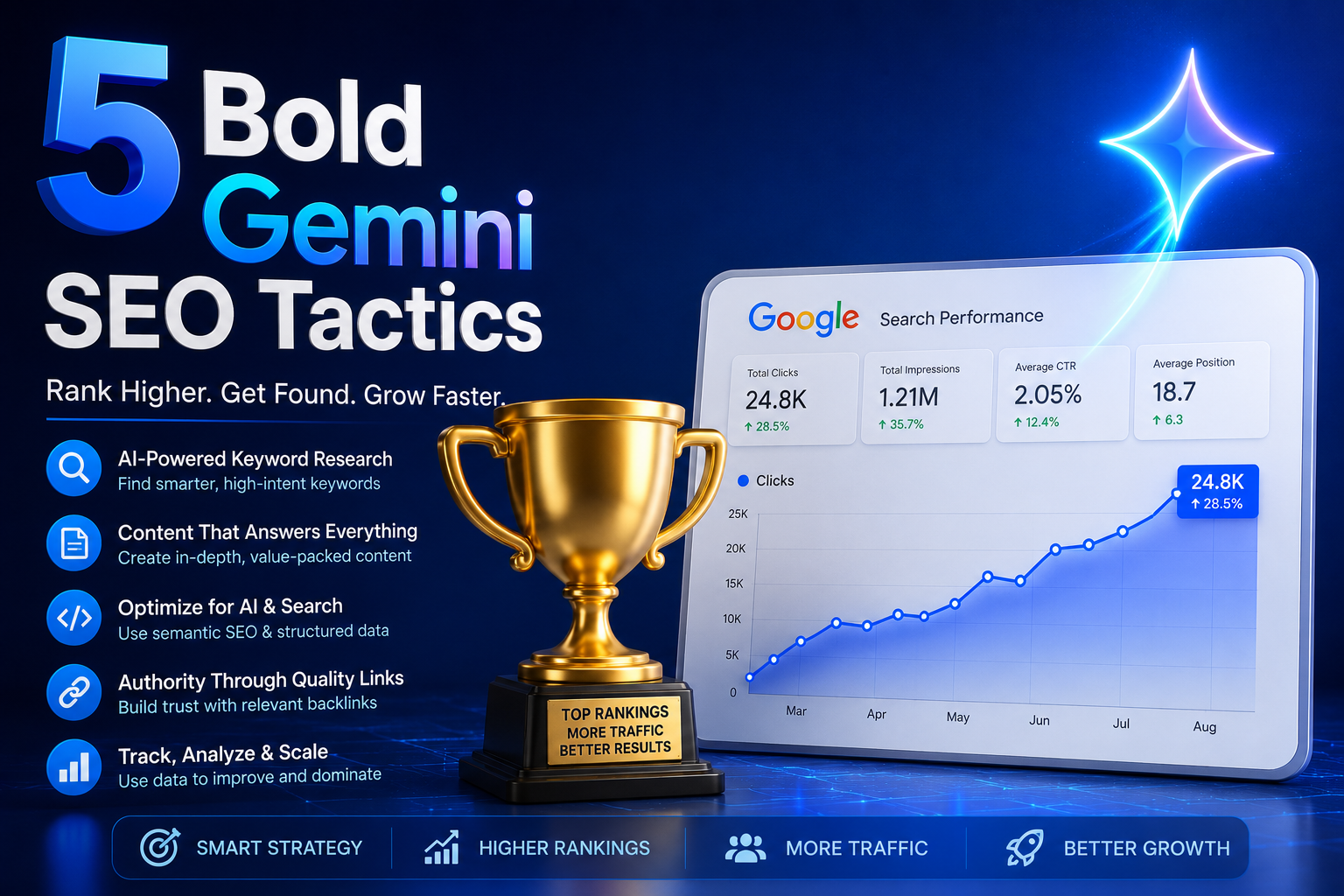
Discover 5 bold Gemini SEO tactics to rank your blog posts #1 on Google effortlessly.
5 Bold Gemini SEO Tactics to Dominate Search and AI Overviews
Search engine optimization is undergoing a massive shift. With Google integrating Gemini—its multimodal Large Language Model—directly into core search experience, organic ranking is no longer just about matching blue links. Today, your content needs to earn selection inside AI Overviews and answer engines.
Optimizing for Gemini, often referred to as Generative Engine Optimization (GEO) or Answer Engine Optimization (AEO), requires a strategy focused on semantic understanding, chunkability, entity authority, and conversational alignment.
The five bold Gemini SEO tactics detailed below will turn your blog into a trusted source for Google’s AI models.
1. Implement Semantic “Chunking” for Information Extraction :5 Bold Gemini SEO Tactics
Gemini processes content by breaking pages into standalone informational units rather than evaluating long-form text as a single monolithic block. To ensure the AI selects your content for summaries, structure your articles into clear, modular “answer chunks”.
Modular Content Design
- Keep paragraphs focused on a single core concept, ideally between 60 and 120 words.
- Position baseline definitions immediately after headings before adding nuanced detail or qualifiers.
- Use descriptive H3 subheadings that frame explicit questions or self-contained sub-topics.
Logical Scaffolding
Always pair dense text blocks with scannable markup. Gemini favors bulleted lists, sequential numbered steps, and clean HTML tables. These visual breaks act as direct extraction points for LLMs generating instant answers.
2. Shift Target Keywords to Conversational Prompt Patterns :5 Bold Gemini SEO Tactics
Traditional keyword research focused on short-tail fragments like “best SEO tools.” Gemini, however, evaluates conversational prompts that reflect natural human speech and complex multi-part questions.
Traditional Keyword:  "Gemini SEO strategies"
Conversational Query: "How do I optimize blog posts for Google Gemini AI Overviews?"
Capturing Natural Language Queries
- Use tools like AnswerThePublic or Google’s People Also Ask to find long-tail, natural-language questions.
- Target “Who, What, Where, Why, and How” query variations inside body paragraphs and headings.
- Frame answers directly using the “Problem-Solution-Example” layout to give Gemini immediate context.
3. Anchor Content with Verified Entities and Schema Markup
Gemini relies on Google’s Knowledge Graph to verify facts, context, and topical authority. If your content lacks clear entity connections, AI systems may disregard it in favor of recognized sources.
Entity Optimization Steps
- Apply Structured Data: Deploy JSON-LD Schema (such as
Article,FAQPage, andHowTo) across all published pages to explicitly declare entities, authors, and relationships. - Cite First-Party Data: Include proprietary research, original survey metrics, or primary case studies to establish undeniable source originality.
- Demonstrate E-E-A-T: Explicitly feature creator bios, credentials, external affiliations, and direct hands-on experience to satisfy Google’s Trust guidelines.
4. Optimize for Multimodal and Freshness Signals
Gemini is inherently multimodal, meaning it reads and interprets text, structured tables, embedded code, images, and video simultaneously. Static, outdated text pages struggle to keep up with dynamic AI-generated SERPs.
Multimodal Checklist
- Image Context: Add detailed, descriptive alt tags and caption text around custom diagrams or charts.
- Video Integration: Embed short-form video explanations with complete transcripts and chapter timestamps.
- Dynamic Updates: Regularly refresh stats, screenshots, and references to maintain the freshness signals Gemini prioritizes.
5. Build Topical Clusters Around Core Intent
To earn citation in Gemini’s AI Overviews, your site must demonstrate comprehensive coverage of a subject area, rather than relying on isolated articles.
| Strategy Component | Purpose for Gemini AI |
|---|---|
| Pillar Page | Serves as the central hub defining the broad industry topic. |
| Cluster Content | Answers sub-questions, edge cases, and specific execution steps. |
| Internal Linking | Maps entity relationships and semantic connection across pages. |
Final Thoughts
Ranking #1 in the era of Gemini requires moving beyond basic keyword density. By structuring pages for AI extraction, mapping content to natural conversational prompts, and reinforcing entity authority through schema, you position your blog to dominate both classic organic rankings and AI-generated search results.
5 Bold Gemini SEO Tactics
yep… that part about small changes got me
that sentence about progress… yeah, keeping that one
Your writing is so eloquent and heartfelt It’s impossible not to be moved by your words Thank you for sharing your gift with the world